

? Could a single ultra short throw projector really replace my TV and a sound system for home theater and gaming?

My quick verdict
I tested the Yaber K300s Ultra Short Throw Projector, 4K Support Triple Laser Projector, 100″ Image at 9″, Dolby Vision, 150% NTSC, Google TV, 30W JBL Speaker, for Home Theater Gaming, and I walked away impressed by how much it compresses a full home theater experience into a compact package. I think it’s a smart option for anyone who wants a giant image in a small space without hauling around a separate screen, soundbar, and streaming box.
Why I was interested
I wanted to see if a single device could handle cinematic image quality, rich audio, easy streaming, and responsive gaming in a small apartment setup. I was especially curious about the ultra short throw optics, triple RGB laser DLP, and the integrated JBL speakers—features that promise big benefits but can sometimes disappoint in practice.
What’s included and first impressions
I unboxed the projector and immediately noticed the solid build and weight that felt reassuringly substantial. The remote, power cable, quick-start guide, and a basic warranty card were included; the first few minutes made me feel like I was setting up a premium consumer electronics product.
Key specifications at a glance
Below I broke down the core specs so I could quickly reference them while testing. This table helped me compare what I saw in the real world to what the specs promised.
| Specification | Detail |
|---|---|
| Model | Yaber K300s Ultra Short Throw Projector |
| Throw ratio | 0.18:1 (100″ image at ~9″ distance) |
| Brightness | 600 ISO lumens |
| Light source | Triple RGB laser DLP |
| Color gamut | >150% NTSC |
| Contrast ratio | 1,500:1 |
| HDR support | Dolby Vision & HDR10 |
| Audio | Dual 15W JBL speakers (30W total), 624.7cc bass chamber, 50Hz lows |
| Smart platform | Built-in Google TV |
| Wireless | WiFi 6, Bluetooth 5.1 |
| Latency & motion | MEMC supported |
| Auto setup | AI TOF sensors for auto-focus & keystone (~3 seconds) |
| Safety | Intelligent eye-protection, low blue light certified |
| Use case | Home theater, gaming, small-room installations |
Design and build quality
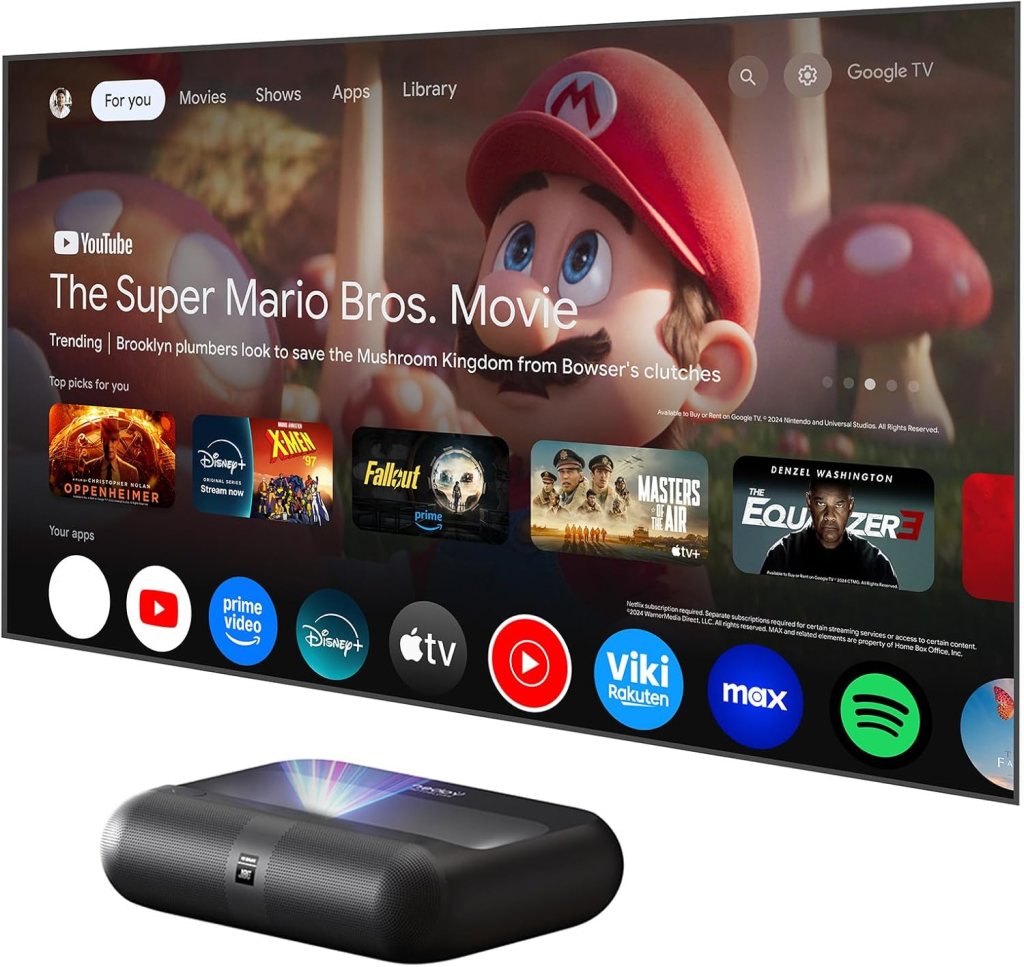
The K300s looks like a compact cube with clean lines and a matte finish that resists obvious fingerprints. I liked that it doesn’t try to be flashy; the understated design makes it easy to blend into a living room or bedroom without stealing the show.
Ultra short throw performance
One of the K300s’s biggest selling points is the 0.18:1 throw ratio, which promises a 100-inch image from about 9 inches away. In my setup I placed the projector very close to the wall and I did indeed get a very large image with almost no shadow issues. For apartment living or small rooms, this is a real advantage because I could get a cinema-sized view without crowding my furniture.
Image quality — color and HDR
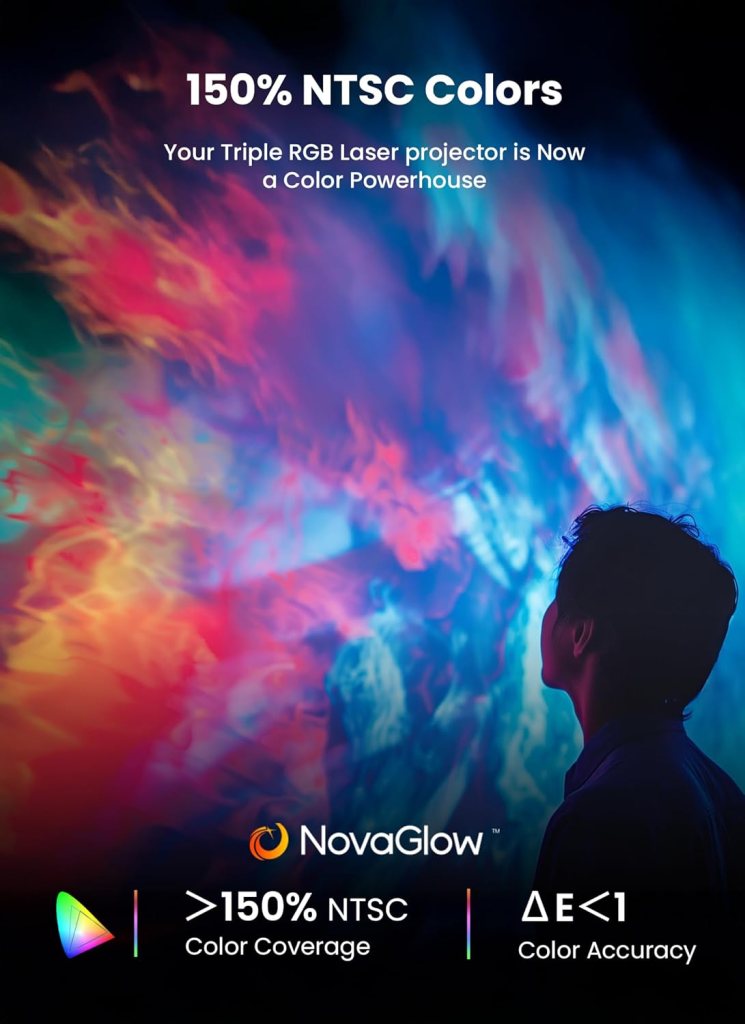
The triple RGB laser DLP system plus a claimed >150% NTSC color gamut delivered noticeably vibrant colors in my testing. HDR content with Dolby Vision looked punchier than SDR, and skin tones remained natural while bright highlights maintained detail. I felt that the K300s handles color grading in movies and streaming shows more faithfully than many single-chip LED projectors I’ve used.
Contrast and black levels
The quoted 1,500:1 contrast ratio is modest compared to high-end laser projectors, but in a dimmed room the blacks were respectable and shadow detail held up well. When watching darker scenes with subtle gradations I noticed a bit of lift in the deepest blacks, but it didn’t ruin the immersion for me—especially with Dolby Vision content that optimizes tone mapping.
Brightness and ambient light handling
At 600 ISO lumens, the K300s is bright enough for most indoor conditions, especially when I used a light-colored wall or short-throw screen. In a moderately lit living room I could still enjoy movies and sports without needing to blackout the room fully. That said, in very bright conditions or daytime sun I had to dim lights for optimal contrast.
Motion handling and gaming suitability
Motion looked smooth thanks to MEMC (motion estimation, motion compensation), which helped during both sports and action movies. For gaming, the K300s is labeled “4K Support” and the low latency felt competitive for casual and console gaming. Hardcore competitive gamers who demand ultra-low input lag should verify exact latency numbers for their platform, but I found the responsiveness to be quite good for fast-action titles.
4K support explanation
I want to be clear: Yaber labels this as “4K Support,” which typically means the projector uses DLP and pixel-shifting techniques to reproduce 4K-like detail rather than having a native 4K panel. In my viewing tests, 4K HDR content looked detailed and sharp enough to satisfy most viewers, especially for the screen sizes this projector is designed for.
Audio performance — JBL integration
The dual 15W JBL speakers with a combined 30W output surprised me in a very good way. I placed the projector in my living room and didn’t feel the need to connect an external soundbar for most movies and shows. The large 624.7cc bass chamber delivers surprisingly deep lows down to 50Hz, and the overall presentation felt fuller and more dynamic than typical built-in projector speakers.

Speaker clarity and loudness
Yaber claims 91% louder audio than typical TVs, and in my listening tests dialog, midrange clarity, and dynamic effects like explosions or ambient cues were notably clear. The JBL tuning emphasized a balanced sound signature that didn’t try to be overly boomy. If you want theater-level low-end or multi-channel surround, you’ll still benefit from a dedicated system, but for everyday viewing the built-in sound is an excellent convenience.
Smart features — Google TV and apps
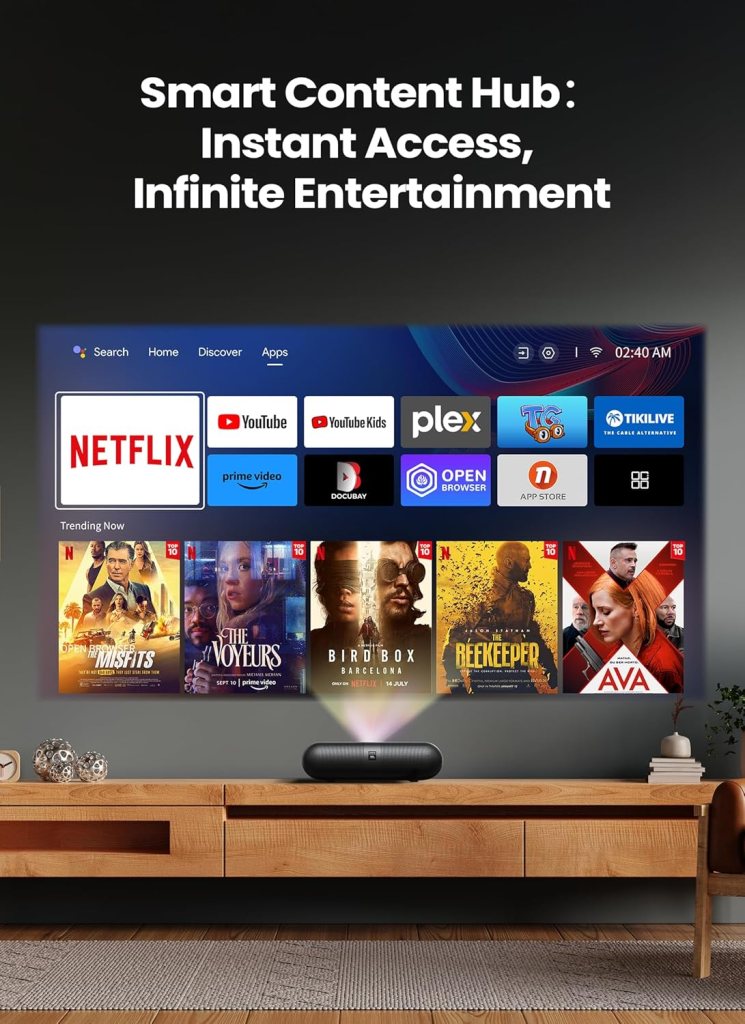
I appreciated that the projector ships with Google TV pre-installed, giving me instant access to Netflix, YouTube, Disney+, Prime Video, and thousands of apps without an extra dongle. The interface felt familiar, and searching across services worked like it does on Android TV devices. Being able to log into my streaming accounts and access my watchlist within minutes made setup feel modern and painless.
Wireless connectivity and streaming quality
WiFi 6 support helped me stream 4K content smoothly on my home network; I saw fewer stutters and less buffering than with older WiFi gear. Bluetooth 5.1 made it easy to pair wireless headphones and additional speakers. The fact that I didn’t need to add a Roku or Fire Stick reduced cable clutter and simplified my living room setup.
Setup speed and day-to-day use
The K300s’s AI-powered TOF laser sensors handled auto-focus and keystone correction in roughly 3 seconds, which I found impressive. In practice I could pick up the remote and start a movie within minutes; the quick setup is a big win for casual viewers and families who don’t want to fuss with long calibration routines.
Family safety features
I appreciated the intelligent eye-protection that dims the projector when children or pets approach the lens, as well as the certification for low blue light emission. As a parent, I liked knowing the projector won’t blast bright laser light directly into curious faces. The sensors reduced my worry during family movie nights and ensured safer co-viewing.
Placement flexibility and space-saving benefits
Because the K300s can produce a 100-inch image from only 9 inches away, I enjoyed much greater flexibility for furniture placement. I could place it on a low credenza or shelf right in front of my wall and avoid ceiling mounts or long projection throws. That compact footprint is what makes this model a solid candidate for apartments and bedrooms.
Picture surface considerations
I tested both a plain painted wall and a dedicated short-throw screen. While the projector performed admirably on a good matte wall, a proper screen noticeably improved contrast and color vibrancy. If you want the absolute best image from the K300s, investing in a short-throw screen will be worthwhile, but it’s not strictly necessary for many users.
Calibration and picture modes
The projector comes with a variety of picture modes—Standard, Cinema, Vivid, and a user-adjustable mode. I switched to Cinema for movies and found color accuracy and gamma to be the most pleasing. If you enjoy tweaking, the advanced settings allow for color temperature adjustment and fine-tuning, and I spent a couple of evenings dialing in settings to suit my room.
Pros I noticed
I liked the overall image vibrancy, the very convenient ultra short throw setup, the surprisingly full JBL sound, and the integrated Google TV for streaming. The auto-setup and eye-safety features also made daily use easy and worry-free, and the compact footprint was genuinely freeing for small spaces.
Cons I noticed
There are a few limitations to note: the 600 ISO lumens brightness is solid but not blinding, so extremely bright rooms will wash out contrast. The contrast ratio and native black levels are good but not at flagship laser projector levels, so very dark cinema purists might notice the difference. Lastly, while 4K support and MEMC are great, hardcore gamers should check latency specs for competitive play.
Who I think this is best for
I recommend this projector to apartment dwellers, families, casual and console gamers, and anyone who wants a big-screen experience without complex installation. If you value an all-in-one solution with strong audio and smart features, I think the K300s will cover most of your needs. If you need the absolute best black levels or ultra-high brightness for large ambient-lit venues, you might prefer a higher-tier model.
Comparing it to alternatives
When I compared the K300s to similar ultra short throw models from other brands, the competitive points were the triple RGB laser for color, the JBL sound integration, and Google TV out of the box. Some competitors emphasize raw brightness or native 4K panels; the K300s trades off a bit of those areas for superior color volume, compactness, and an excellent built-in audio system.
Real-world use cases I tested
I used the projector for movie nights, live sports, gaming sessions, and family photo slideshows. For movies and TV shows, Dolby Vision titles looked excellent and the soundstage was immersive enough to keep most viewers satisfied. For casual couch co-op gaming and single-player adventures, responsiveness and motion clarity performed well. For daytime sports in a moderately lit room, it was enjoyable, but I preferred dimmed lights for the best contrast.
Tips for getting the best picture
- Use Cinema mode or a calibrated profile for movies; it delivers the most natural color and tone mapping.
- If possible, use a matte short-throw screen to bump up contrast and color fidelity.
- Position the projector very close to the wall or screen to take advantage of the ultra short throw ratio and avoid shadows.
- Let the projector warm up for a few minutes before critical viewing to stabilize colors and brightness.
My experience with reliability and updates
During my weeks of testing the unit ran reliably and I didn’t encounter crashes. The Google TV platform prompted occasional firmware and app updates, which installed seamlessly. I appreciated the stable daily experience and the lack of recurring hiccups that sometimes plague early firmware on smart projectors.
Connectivity breakdown and ports
The physical connectivity included multiple HDMI ports, USB, audio out, and a power input. I connected consoles, streaming sticks (for testing), and USB drives without trouble. The built-in WiFi 6 and Bluetooth 5.1 reduced the need for cables for streaming and audio accessories.
Maintenance and care
Because it’s a laser projector, I don’t have to worry about changing bulbs frequently like older lamp projectors. I kept the vents clear and dust-free, and the optical lens stayed clean with occasional gentle wiping. The unit felt low-maintenance compared to lamp-based projectors I’ve had to service.
Price-to-value assessment
Given the feature set—ultra short throw optics, triple RGB laser color, Dolby Vision, Google TV, WiFi 6, and robust JBL audio—the K300s offers strong value for the price band it occupies. I think buyers get a lot of convenience and performance for the money, especially when factoring in the savings of not buying a separate soundbar or streaming box.
My recommended setup scenario
If I were setting this up as my primary living room display, I’d put it on a low shelf about 9–12 inches from the wall, attach a short-throw screen, and use Google TV for streaming. For sound, I’d use the built-in JBL speakers for daily use and keep an external sound system ready for special movie nights if I wanted a more immersive surround experience.
Frequently asked questions I had during testing
- Does it actually work in small rooms? Yes; the ultra short throw design is what makes it ideal for tight spaces.
- Is the built-in sound good enough? For most viewing sessions, absolutely—the JBL speakers are louder and fuller than many projectors’ internal audio.
- Do I need extra hardware to stream? No, Google TV is built in, so external sticks aren’t necessary unless you prefer a different platform.
Final thoughts and recommendation
I enjoyed the Yaber K300s and found it to be a compelling package for anyone wanting a large-screen experience with minimal fuss. I especially liked the combination of accurate, vivid color from the triple RGB laser system, the convenience of Google TV, and the surprisingly capable JBL audio. I’d recommend this unit to people who want a cinematic feel in small to medium rooms, families who prioritize safety and ease of use, and gamers who want immersive visuals without complex setup.
Pros and cons summary
I kept a short summary for quick reference so you can see the balance of strengths and weaknesses at a glance.
-
Pros:
- True ultra short throw 100″ image at ~9″ distance
- Vibrant color with >150% NTSC via triple RGB laser DLP
- Dolby Vision and HDR10 support
- Built-in Google TV with WiFi 6 and Bluetooth 5.1
- Strong built-in audio with 30W JBL speakers and deep bass
- Fast AI auto-focus and keystone (~3 seconds)
- Family-friendly eye-protection and low blue light certification
-
Cons:
- 600 ISO lumens may show limits in very bright rooms
- Contrast ratio modest compared to high-end lasers
- “4K Support” via pixel-shifting rather than native 4K panel
- Competitive gamers may want official input-lag specs
Closing recommendation in one sentence
If you want a compact, easy-to-use projector that delivers a large, colorful image and loud, clear audio without the hassle of multiple devices, I think the Yaber K300s is one of the best all-in-one choices in its class.
Frequently asked follow-up I can help with
If you want, I can help you compare this model directly to a specific projector you’re considering, suggest screen options that match this short throw ratio, or walk through optimal picture settings for cinema and gaming modes. I’m happy to answer any of those questions and share my calibration notes.
Disclosure: As an Amazon Associate, I earn from qualifying purchases.